Emotional Health Practitioner Certificate Program

A structured, cohort-based program designed to develop the knowledge, skills, and professional confidence needed to provide responsible psychosocial support.

Mentalis Academy’s Certificate Program was created for individuals who wish to move beyond personal learning toward the thoughtful and responsible practice of psychosocial and relational support.

The program prepares participants for professional helping roles through a structured developmental process integrating psychological understanding, reflective practice, relational awareness, and applied intervention learning. Rather than offering isolated educational experiences, the curriculum guides participants through a progressive learning journey that deepens both conceptual understanding and practical competence.

Participants are supported not only in acquiring knowledge, but in developing the discernment, presence, and ethical grounding required for responsible psychosocial support practice. Graduates develop the foundations needed to accompany individuals through emotional and relational challenges across a variety of community, professional, and supportive practice contexts.

Students talking and laughing in a lecture hall.
For Emerging and Developing Practitioners

This program is designed for individuals seeking meaningful work in people-centered roles who want structured psychological education grounded in real-world practice.

Participants often include:

  • Career changers entering support or helping professions

  • Coaches, educators, and wellness practitioners seeking deeper psychological grounding

  • Individuals already working with people who want stronger theoretical and ethical foundations

  • Professionals seeking an additional certification aligned with emotional health practice

Clarification
This program provides structured education and professional development. It is not psychotherapy training and does not lead to clinical licensure.

man in white dress shirt sitting on red couch using silver macbook

Who this program is for

Program Structure
  • Format
    Cohort-based professional certificate

  • Duration
    Approximately 9 months

  • Start Dates
    September and January

  • Curriculum
    8-module developmental pathway

  • Learning Model
    Guided online study + live integration seminars

selective focus of woman behind pink flowers holding red Samsung bridge camera about to take photo of flower

Program Snapshot

Learning Experience
  • Integration seminar for every module

  • Cohort discussion and reflective dialogue

  • Practicum experiences (Phase 2)

  • Two integration projects

  • Instructor guidance throughout

Outcome
Professional Certificate in Emotional Health Practice

  • eligibility for affiliate association membership in ANQ, IACTM and ANNC.

From Insight to Professional Capacity

Emotional health practice develops through reflection, dialogue, and integration over time.

Learning unfolds within a cohort environment where participants engage psychologically, relationally, and intellectually with the material. Concepts are explored not only as knowledge, but as lived processes influencing perception, communication, and professional responsibility.

Participants are supported through:

  • live integration seminars linked to each module

  • guided cohort dialogue

  • structured reflective exercises

  • applied learning assignments

  • written integration milestones

  • ongoing instructor presence

The program gradually supports the emergence of professional identity grounded in awareness and ethical practice.

Diverse team collaborates around a table in office.

A Developmental Learning Experience

Participants progress together within a structured cohort environment designed to support accountability, reflective depth, and the gradual development of professional identity. The program combines guided study, applied learning, and ongoing instructor support within a coherent educational framework.

What the Program Includes

  • Guided progression through Modules 1–8

  • Comprehensive workbooks for each module

  • Live integration seminars (8 seminars, one per Module)

  • Cohort discussion environment

  • Practicum experiences (Phase 2)

  • Instructor guidance throughout the program

  • Two formal integration papers

  • Certification evaluation process

Intakes:

  • September cohort (completion designed for mid-June)

  • January cohort

Diverse team collaborating around a laptop in office.
A Structured Cohort Learning Experience

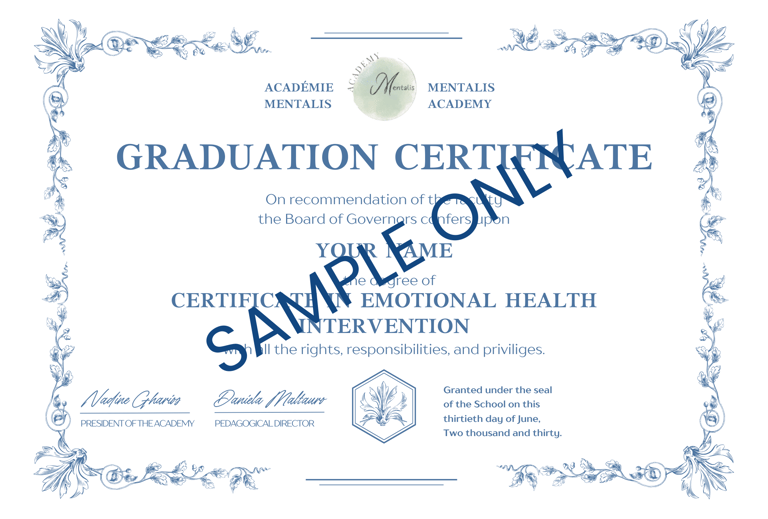
Upon successful completion, graduates receive the designation:

Certified Mentalis Emotional Health Practitioner™

The certification recognizes completion of a structured professional education pathway integrating emotional health knowledge, psychosocial intervention skills, applied learning, and ethical practice.

Professional Membership:

Graduates may apply for membership within Mentalis Academy’s affiliated professional associations such as ANQ, IACTM and ANNC, supporting continued professional development and peer connection.
(Membership subject to each association’s admission criteria.)

Mentalis Academy programs are grounded in established psychological knowledge, relational understanding, and trauma-informed perspectives informed by extensive clinical and interdisciplinary experience. The curriculum supports the development of practical skills, reflective capacity, and ethical awareness for working thoughtfully with people across diverse professional contexts.

The certificate represents advanced professional education and is distinct from regulated psychotherapy or psychology licensure pathways.

Certification and Professional Recognition
a graduation cap and a green tassel on a piece of wood

🔹 PHASE 2 — APPLIED PRACTICE (Modules 5–8)

Phase 2 develops the relational and applied skills required for effective psychosocial intervention.

MODULE 5 — Coping Mechanisms

Understanding adaptive and maladaptive coping strategies and their role in emotional functioning and intervention contexts.

MODULE 6 — Active Listening and Self-Observation in Psychosocial Intervention

Development of listening presence, attunement, and practitioner self-awareness during intervention processes.

MODULE 7 — Mental Health Intervention Techniques: Theoretical Models and Practical Applications

Introduction to theoretical models and structured application of intervention approaches within psychosocial settings.

MODULE 8 — Professionalism and Ethics

Professional identity, ethical responsibility, boundaries, and standards for safe and respectful practice.

Phase 2 Learning Components

  • Live integration seminars

  • Practicum learning experiences

  • Applied assignments and reflective discussion

  • Instructor-supported development

  • Final Integration Paper / Capstone

Program Structure

An Eight-Module Professional Formation Pathway

The certificate unfolds across two developmental phases.
🔹 PHASE 1 - FOUNDATIONAL DEVELOPMENT (Modules 1–4)

Phase 1 develops the internal capacities required before practicing psychosocial intervention.

MODULE 1 - Embodied Self-Awareness

Participants cultivate awareness of internal experience through exploration of attention, embodiment, and reflective self-observation, establishing the practitioner’s primary tool: awareness of self.

MODULE 2 - Emotional Processes and Regulation Capacity

Exploration of emotional development, emotional intelligence, and regulation processes shaping behavior, perception, and relationships.

MODULE 3 - Foundations of Psychological Well-Being

Participants examine presence, authentic communication, empathy, fulfillment, and growth as foundations for sustainable emotional functioning.

MODULE 4 - Relational Dynamics and Pattern Awareness

Study of relationship cycles, communication patterns, conflict processes, and opportunities for growth within relational systems.

Phase 1 Learning Components

  • Live integration seminar for each module

  • Cohort discussion and guided reflection

  • Workbook integration exercises

  • Instructor developmental feedback

  • Integration Paper submitted after Module 4

Transition to Phase 2

Completion of Phase 1 represents a developmental milestone.

Participants apply to continue into Phase 2, demonstrating readiness to move from foundational understanding toward applied intervention practice.

Woman wearing headphones smiles while looking at laptop.

Enrollment & Program Investment

A Structured Path Toward Emotionally Informed Practice

The Mentalis Emotional Health Practitioner Certificate Program offers a coherent and supported pathway for individuals seeking thoughtful professional preparation and meaningful engagement with human experience.

Enrollment is intentionally limited to preserve cohort depth, reflective learning, and meaningful instructor engagement.

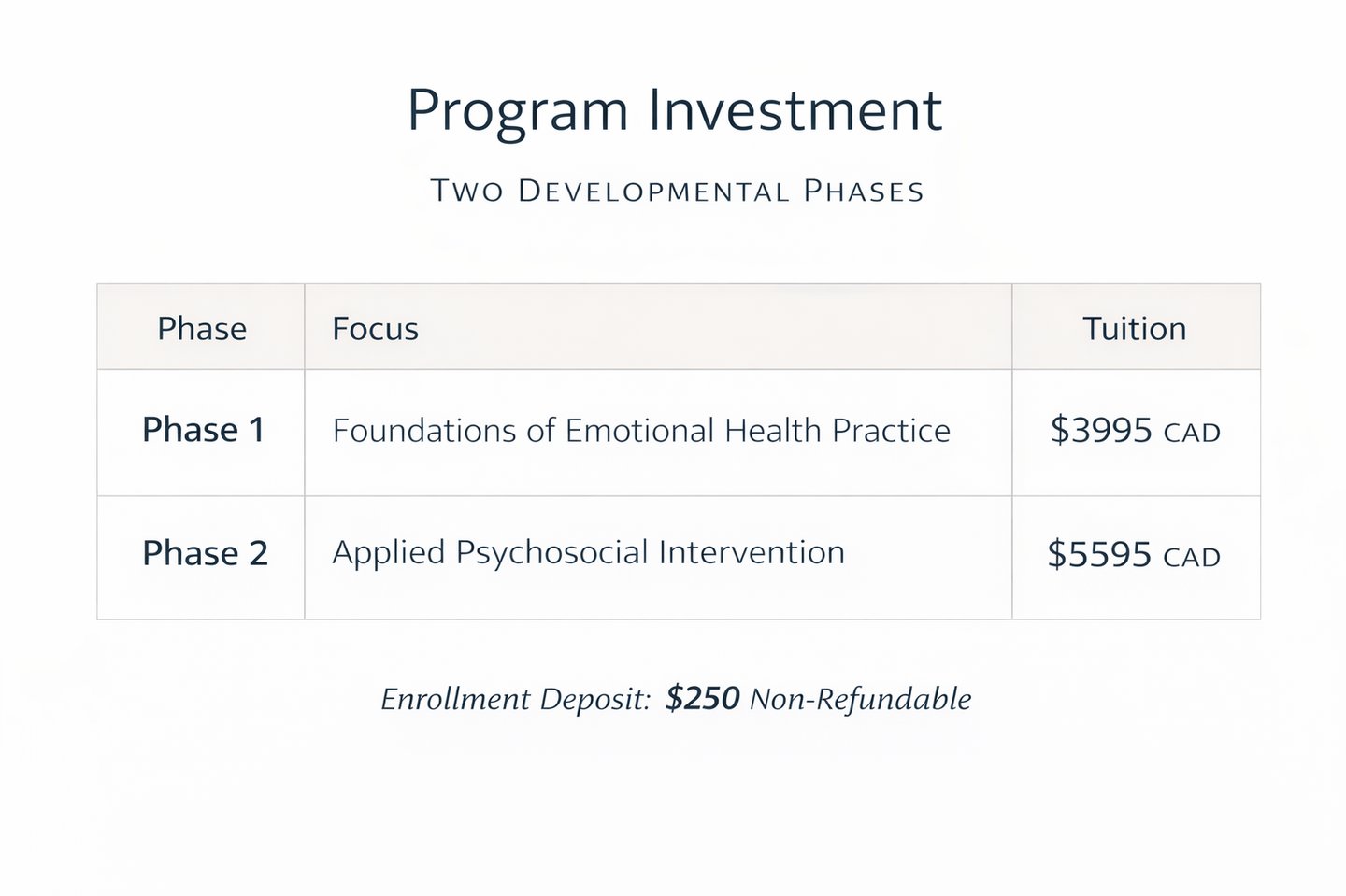
Program Investment

The certificate program unfolds across two developmental phases.
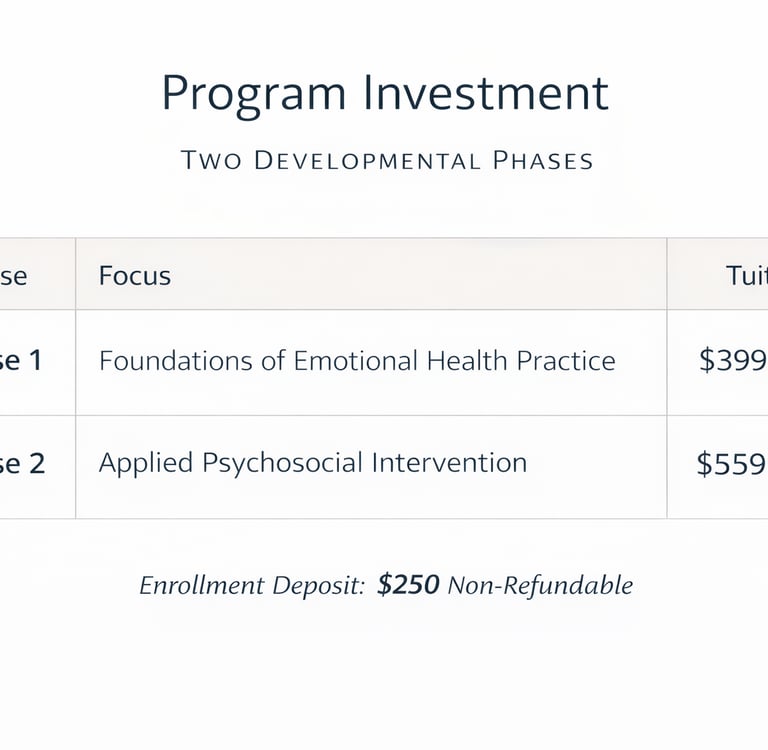
Phase 1 — Foundations of Practice

$3995 CAD

Phase 1 develops the internal capacities required before practicing psychosocial intervention.

  • A $250 non-refundable deposit is required to reserve a place within the cohort. Click Register for Admission to secure your spot.

  • Payment of the balance may be made in two installments, one month apart at the start of the cohort session.

Phase 2 — Applied Psychosocial Intervention

$5,595 CAD

Phase 2 develops relational and applied competencies through practicum learning and supervised integration.

  • Payment may be made in three monthly installments over consecutive months.

Enrollment Deposit

A $250 non-refundable deposit is required to reserve a place within the cohort for both Phase 1 and Phase 2. This deposit will be deducted from the total fee.

  • The deposit secures enrollment until the cohort start date.

  • The remaining balance is due at the beginning of the cohort (September or January intake).

  • When an installment plan is selected, payments are processed automatically on a monthly basis once the program begins.

Next Steps

Participants ready to engage in structured emotional health education may apply for cohort admission below.

Apply for Cohort Admission

Request Program Information

Admission includes a brief suitability review to ensure alignment with program expectations.